
Petals & Planets July 29, 2026
“If we learn to open our hearts, anyone, including the people who drive us crazy, can be our teacher.” Pema Chödrön
A Practice for Listening, Learning & Gratitude
There are people whose words stay with us long after the conversation has ended.
A teacher who saw something in us before we could see it ourselves.
A parent or grandparent whose wisdom quietly became part of who we are.
A mentor who offered a hand at exactly the moment we needed one.
A friend who told us the truth with enough love to help us hear it.
Sometimes the teacher is someone we never expected.
Sometimes the lesson arrives through an experience we would never have chosen.
And sometimes, years later, we realize that something we once heard only in passing had been quietly taking root all along.
This is one of those moments…
A time to pause and remember the people, teachings, experiences, and moments of grace that have helped shape the person you are becoming.
Guru Purnima is traditionally a time to honor the guru—the teacher or guide who helps illuminate the path. But the spirit of gratitude can extend beyond a formal teacher or spiritual tradition. We can honor anyone who has helped us see more clearly, live more consciously, or remember something essential about ourselves.
And perhaps the deepest form of gratitude is not simply remembering what we were taught.
It is living it.
The wisdom we receive becomes meaningful when it changes the way we move through the world.
When we become kinder because someone once showed us kindness.
When we become braver because someone believed in us.
When we share what we have learned because someone once shared their wisdom with us.
Learning becomes a circle.
We receive.
We integrate.
And eventually, we give.
This practice invites you into that circle—not simply to ask what you know, but to listen for what life has been teaching you all along.
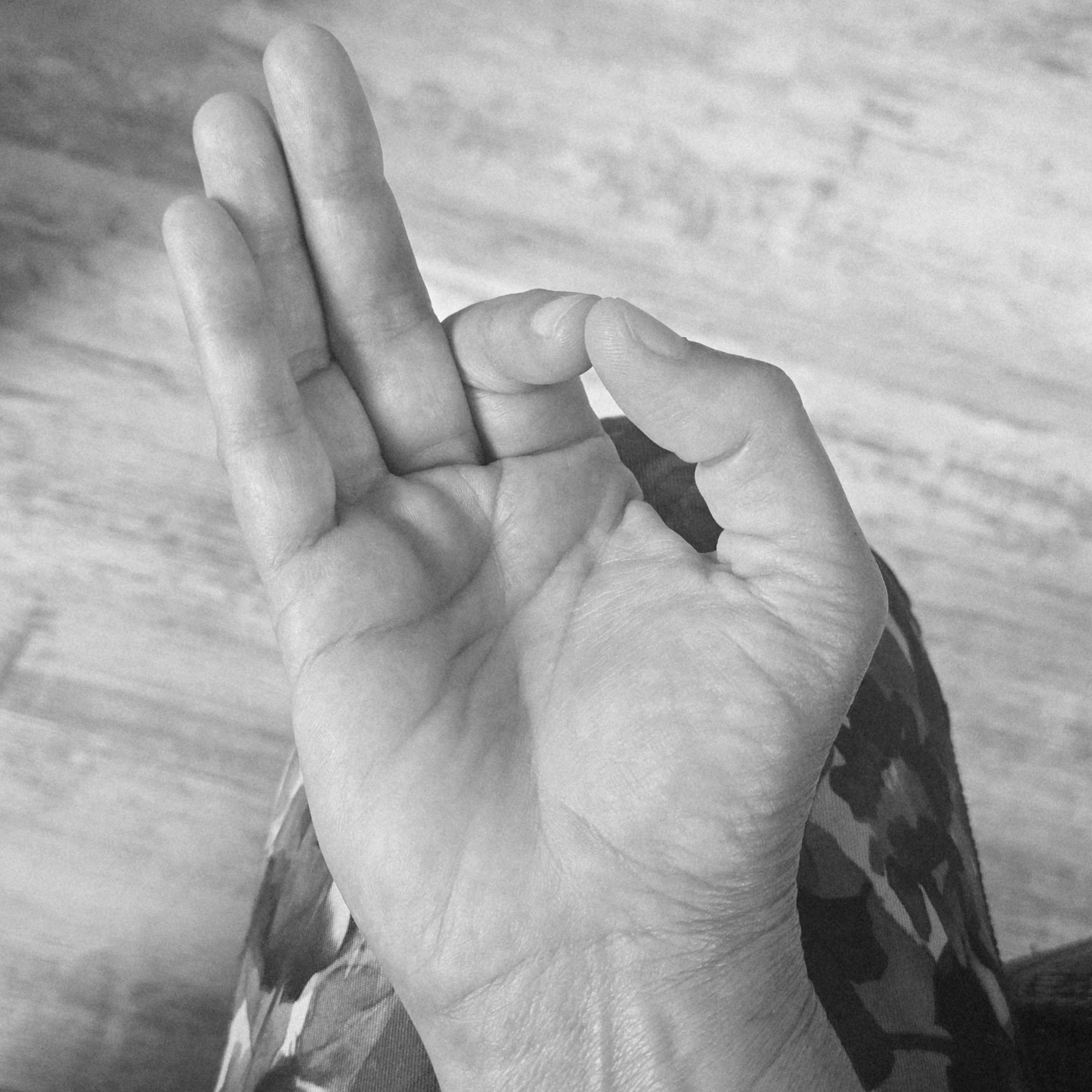
GYAN MUDRA
Gesture of Receptive Wisdom
A gentle hand gesture supporting contemplation, inner listening, and the quiet integration of knowledge, creating space to receive wisdom with humility and allow what has been learned to become part of how we live.
How to Practice
Sit comfortably with your spine gently upright.
Rest both hands on your thighs or knees with your palms facing upward.
Touch the tip of your index finger gently to the tip of your thumb on each hand, creating a soft circle.
Allow your remaining three fingers to extend naturally without tension.
Relax your shoulders, lengthen your spine, and soften your gaze or close your eyes.
Breathe naturally for 5–15 minutes.
Supportive Qualities
Cultivates quiet contemplation and inner listening
Encourages openness to learning and reflection
Supports the integration of experience into wisdom
Invites humility, gratitude, and thoughtful awareness
A Gentle Note
Gyan means “knowledge” or “wisdom.” The simple meeting of thumb and index finger can be contemplated as a meeting between the individual and something greater than the individual—a reminder that wisdom is not only something we acquire, but something we become willing to receive.
Let this be a practice of listening rather than searching.
You do not have to solve anything.
You do not have to understand everything.
Simply become quiet enough to notice what has already been trying to teach you.
🔊 Mantra | OM GURUBHYO NAMAHA
Pronunciation: Ohm Goo-roo-bh(soft b sound)-yo Nah-mah-hah
A simple offering of respect and gratitude to the gurus—the teachers, guides, mentors, and sources of wisdom who have helped us see more clearly.
You may hold one particular teacher in your heart as you practice, or allow the mantra to honor all those who have taught you something meaningful—including those whose lessons arrived through unexpected circumstances.
For Beginners
If you are new to mantra practice, begin simply with Om.
Sit comfortably in Gyan Mudra and repeat Om softly with each exhale for 5–10 minutes. Allow the sound to be gentle and natural. There is nothing to perfect.
As you become comfortable with the practice, you may gradually explore the full mantra.
Rhythm & Practice
Sit in Gyan Mudra and begin with three slow breaths.
On each exhale, softly repeat:
Om Gurubhyo Namaha or simply OM
Chant or whisper the mantra aloud, or repeat it silently.
Continue for 5–10 minutes or 27 repetitions.
After the final repetition, remain still for a few moments.
Bring to mind one person who has meaningfully shaped your life.
Allow yourself to feel gratitude without needing to explain it.
Then gently ask:
What have I received that is now mine to embody?
And finally:
What wisdom am I ready to pass forward?
A Gentle Note A teacher's influence does not end when the lesson ends. Sometimes the most beautiful way to honor someone who has taught us is to carry their wisdom forward—not by becoming a copy of them, but by allowing what they gave us to become something uniquely our own.
Essence: I listen with an open heart. I honor what I have been taught. I carry wisdom forward with gratitude.
🌿 ESSENTIAL OILS FOR SUPPORT
These essential oils support reflection, reverence, emotional steadiness, and the quiet openness needed to receive wisdom and integrate what we have learned.
Frankincense | Reflection & Sacred Presence
Frankincense has a long history of use in spiritual and contemplative traditions. Its warm, resinous aroma creates a sense of quiet and presence, making it a natural companion for reflection, meditation, and moments of gratitude. Learn More
Cedarwood | Grounded Wisdom & Stability
Cedarwood offers a deeply grounding aromatic experience. Its warm, woody character supports a sense of steadiness and rootedness, encouraging us to remain present while reflecting on the lessons and experiences that have shaped us. Learn More
Lavender | Peaceful Reflection & Receptivity
Lavender is widely valued for its calming and soothing aromatic qualities. Its gentle presence can create an atmosphere conducive to rest, reflection, and quiet listening—allowing the mind to soften enough for insight to emerge without force. Learn More
How to use: Diffuse during meditation or quiet reflection, or dilute properly before topical application according to essential-oil safety guidelines.
🌸 BACH FLOWER REMEDIES
These flower remedies support humility, discernment, confidence, and the willingness to remain open to learning as we honor those who have helped shape our path.
Cerato | Inner Knowing
Cerato is traditionally associated with trusting one's own inner knowing rather than continually seeking reassurance or external confirmation. It offers a beautiful reminder that teachers can illuminate our path without taking the place of our own discernment. Learn More
Walnut | Protection During Growth & Transition
Walnut is traditionally used during periods of change, helping one remain centered while integrating new influences and moving forward with greater independence. It reminds us that receiving wisdom does not mean losing ourselves within another person's way of seeing. Learn More
Chestnut Bud | Learning Through Experience
Chestnut Bud encourages conscious learning from experience. It invites us to pause, recognize patterns, and allow what we have lived through to become wisdom rather than simply repeating what has come before. Learn More
How to use: Take as directed in water or under the tongue throughout the day.
Note: This document is intended for informational and educational purposes. Flower remedies & essential oils should be used as complementary wellness practices — not as replacements for professional medical or mental health care. Always consult a qualified healthcare provider before beginning any new health regimen, particularly if you are pregnant, nursing, taking medications, or managing a chronic health condition.
🌿 A SIMPLE RITUAL
Find a quiet space where you will not be interrupted.
Place a photograph, small object, flower, or another meaningful reminder of someone who has taught or guided you nearby.
Sit comfortably and settle into Gyan Mudra.
Take three slow, steady breaths.
On each exhale, softly repeat:
Om Gurubhyo Namaha or Om
Allow the name or memory of one teacher, mentor, guide, loved one, or life experience to come to mind.
Then gently reflect:
Who has helped me become more fully myself?
What wisdom have I received that I want to carry forward?
What have I learned that is now mine to share?
You do not need to find the perfect answer.
Let gratitude arise naturally.
After 5–10 minutes, release the mudra and rest your hands comfortably in your lap.
Place your hand over your heart and say:
“May I meet myself today with the same love I so freely offer others.”
Then offer this cycle's reflection:
“May I honor what I have received, embody what I have learned, and pass forward what may help another.”
Rest in the quiet for a moment before returning to your day. Namaste.
With Love & Care,
Carlie Love, LMBT, CIMI
Petals & Planets | Seasonal Wisdom for Body & Soul
