
Petals & Planets August 28, 2026

“Love is like a butterfly, a rare and gentle thing.” Dolly Parton
A Practice for Release & Spacious Becoming
There are moments when life asks us not to add something new, but to make room.
To loosen our grip.
To set down what we have carried for too long.
To release the expectations, identities, stories, and old ways of seeing that may once have served us but no longer feel like home.
Sometimes we know exactly what needs to go.
Sometimes we only know that something feels heavy.
And sometimes, we discover that what we thought we needed to release was simply a way of seeing that had become too small for who we are becoming.
This is one of those moments.
A moment to step back.
To breathe.
To see more spaciously.
We do not always need to understand everything before we can let it soften.
Some things become clear only after we stop holding them so tightly.
Release does not have to be dramatic.
It can be gentle.
It can be a quiet willingness to say:
I don't need to carry this anymore.
Perhaps there is something you have outgrown.
Perhaps there is an old story that no longer tells the truth.
Perhaps there is a version of yourself you have been trying to return to, when life is actually inviting you somewhere new.
You do not have to force the next chapter.
First, make space.
Let what is finished be finished.
Let what is uncertain remain uncertain for a little while.
Allow yourself to discover what becomes possible when you are no longer carrying everything with you.
Sometimes freedom begins not with knowing where we are going,
but with becoming willing to put something down.
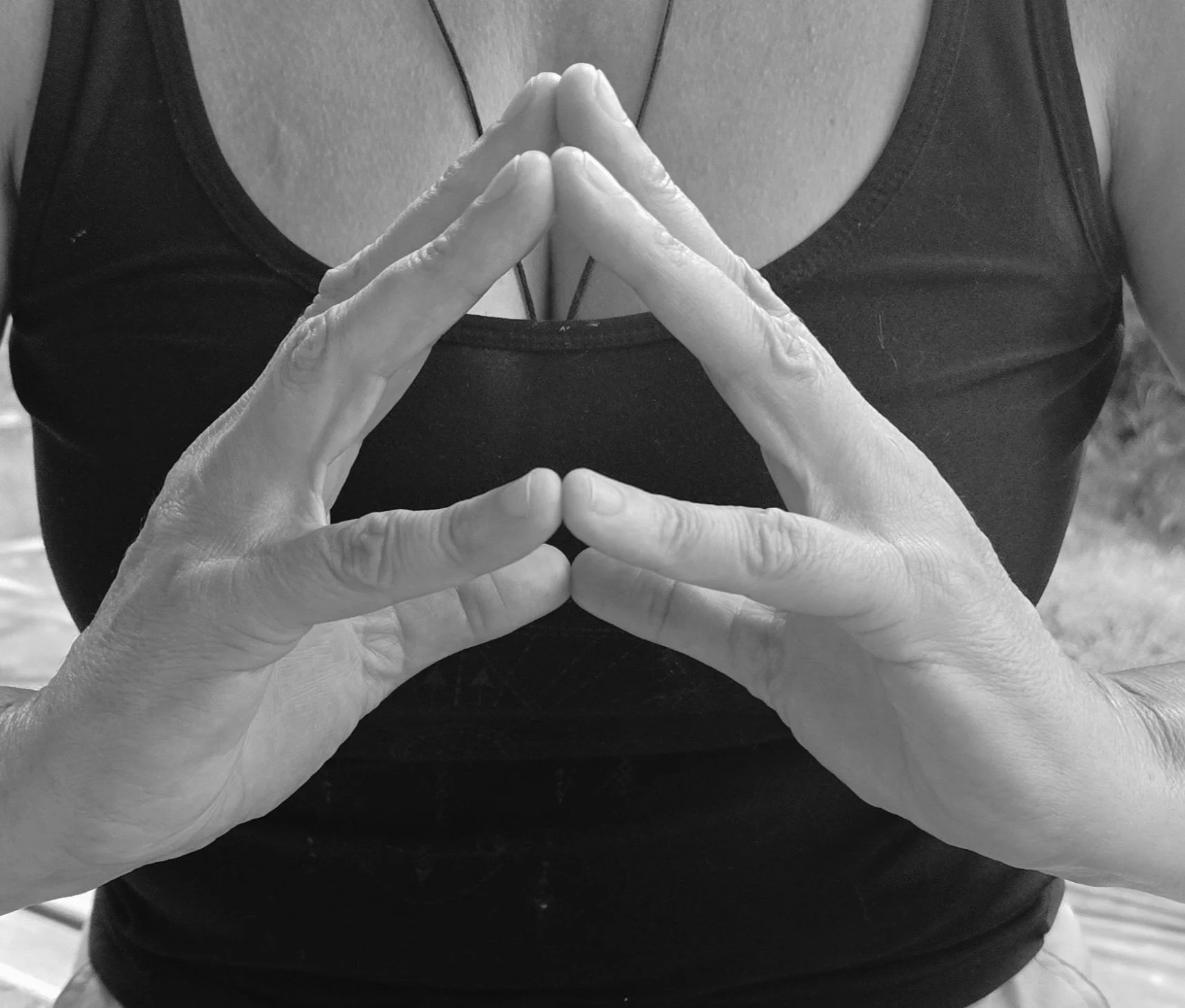
Hakini Mudra
Gesture of Integration & Inner Knowing
A contemplative hand gesture supporting focused awareness, integration, and the quiet meeting of thought and intuition, inviting us to step back from mental noise and allow a larger perspective to emerge.
How to Practice
Sit comfortably with your spine gently upright.
Bring both hands in front of your chest.
Touch the fingertips of both hands lightly together, creating a soft dome with the palms separated.
Keep the fingers relaxed.
Allow the thumbs to touch each other gently.
Rest the hands comfortably at the level of the heart or upper abdomen.
Relax your shoulders and lengthen your spine.
Allow your gaze to soften or close your eyes.
Breathe naturally for 5–15 minutes.
Supportive Qualities
Encourages focused and spacious awareness
Supports reflection and integration
Invites a balance between thought and intuition
Creates space for clarity without forcing an answer
Hakini Mudra is traditionally associated with concentration, integration, and inner awareness.
Rather than trying to think your way toward an answer, allow the gesture to become a reminder that different kinds of knowing can coexist.
The mind can observe.
The heart can feel.
The body can respond.
And sometimes clarity arrives when we stop insisting that one part of ourselves have all the answers.
As you sit, notice what becomes quieter when you stop trying to solve everything.
You may discover that some things do not need to be figured out.
They simply need to be let be.
A Gentle Note
Prana is often translated as life force or vital energy.
Rather than trying to create more energy, this practice invites you to become aware of the aliveness that is already present.
Notice your breath.
Notice the subtle sensations in your body.
Notice the places where you feel curious, hopeful, or quietly drawn toward something new.
There is no need to decide what any of it means.
Simply notice.
Sometimes what is emerging becomes clearer when we stop asking it to explain itself.
🔊 Mantra | OM MANI PADME HUM
Pronunciation: Ohm MAH-nee PAHD-may HOOM
For those with an established mantra practice, Om Mani Padme Hum offers a deeper practice of compassion, wisdom, and transformation.
The mantra is traditionally associated with Avalokiteshvara, the bodhisattva of BIG compassion, and is widely practiced within Tibetan Buddhist traditions.
For Beginners
If you are new to mantra practice, begin with OM.
Sit comfortably in Hakini Mudra and repeat OM softly with each exhale for 5–10 minutes. Allow the sound to be gentle and natural. There is nothing to perfect.
As you become comfortable with the practice, you may gradually explore the full mantra.
Rhythm & Practice
Sit in Hakini Mudra and begin with three slow breaths.
On each exhale, softly repeat:
OM MANI PADME HUM or simply OM
Allow the mantra to become steady and rhythmic.
You may repeat it aloud, whisper it, or practice it silently.
Continue for 5–10 minutes or 27 repetitions.
As you practice, imagine that you are not forcing anything away.
Instead, you are allowing what no longer needs to remain to soften naturally.
Let compassion be part of letting go.
Compassion for what you are ready to leave behind.
Compassion for the parts of yourself that held on because they were trying to protect you.
And compassion for the person you are becoming.
After the final repetition, sit quietly.
Let the mantra dissipate into silence.
Remain there for a few breaths.
Then gently ask:
What am I ready to stop carrying?
What old story no longer needs to define me?
What becomes possible when I create more space within myself?
Do not force a response.
Let the questions remain open.
Perhaps a word comes.
Perhaps an image.
Perhaps nothing at all.
All of it is welcome.
Remain in stillness for 5–10 minutes.
When you are ready, release the mudra, place your hands over your heart, and say:
“May I meet myself today with the same love I so freely offer others.”
Then offer this cycle's reflection:
“May I let go of that which does not belong to me with ease and grace, make peace with what is now complete, and trust the spaciousness that remains. I let go of what I no longer need to carry. I make room for clarity, compassion, and a freer way of being. And so it is.”
🌿 ESSENTIAL OILS FOR SUPPORT
These essential oils support a sense of warmth, emotional spaciousness, grounding, and gentle release during periods of reflection and transition.
Cypress | Release & Renewal
Cypress has a fresh, green, woody aroma that has long been associated with transition, ritual, and renewal. Its character makes it a beautiful aromatic companion for moments when we are consciously releasing one chapter and allowing another to unfold. Learn More
Lavender | Softening & Peace
Lavender offers a gentle, familiar aroma associated with calm and relaxation. It provides softness to the practice, reminding us that release does not have to be forced. Learn More
Frankincense | Perspective & Presence
Frankincense brings a warm, resinous quality traditionally associated with meditation and contemplative practice. Its grounding presence can help create a quiet atmosphere for reflection and integration. Learn More
How to use: Diffuse during meditation or quiet reflection, or dilute properly before topical application according to essential-oil safety guidelines.
🌸 BACH FLOWER REMEDIES
These flower remedies support confidence, direction, and a willingness to meet the unknown with greater trust.
Walnut | Protection During Change
Walnut is traditionally associated with transitions and periods when we are becoming less influenced by old patterns or outside expectations. It offers a symbolic reminder to remain centered while moving from what has been familiar toward what is becoming. Learn More
White Chestnut | Quieting Repetitive Thought
White Chestnut is traditionally associated with recurring thoughts and mental loops. Its traditional use reflects the invitation to step out of repetitive thinking and allow greater spaciousness around the mind. Learn More
Willow | Letting Go of Resentment
Willow is traditionally associated with feelings of bitterness, resentment, or dwelling on what has happened. Its symbolic invitation is toward acceptance, personal responsibility, and a willingness to reclaim one's energy rather than remaining bound to the past. Learn More
How to use: Take as directed in water or under the tongue throughout the day.
Note: This document is intended for informational and educational purposes. Flower remedies & essential oils should be used as complementary wellness practices — not as replacements for professional medical or mental health care. Always consult a qualified healthcare provider before beginning any new health regimen, particularly if you are pregnant, nursing, taking medications, or managing a chronic health condition.
There is a kind of freedom that arrives quietly.
Not because everything has been solved.
Not because every question has been answered.
But because we have finally stopped asking ourselves to carry what is no longer ours to hold.
Release is not rejection.
It is recognition.
Recognition that something has served its purpose.
Recognition that we have changed.
Recognition that making room is sometimes the most courageous form of moving forward.
You are allowed to outgrow an old story.
You are allowed to see something differently.
You are allowed to put down what once felt necessary.
And you are allowed to leave some questions unanswered.
Perhaps spaciousness is not emptiness at all.
Perhaps it is the room where something truer can finally be heard.
Let yourself soften.
Let yourself let go.
Let yourself become spacious enough to receive what comes next.
Rest in the quiet for a moment before returning to your day. Namaste.
With Love & Care,
Carlie Love, LMBT, CIMI
Petals & Planets | Seasonal Wisdom for Body & Soul
