
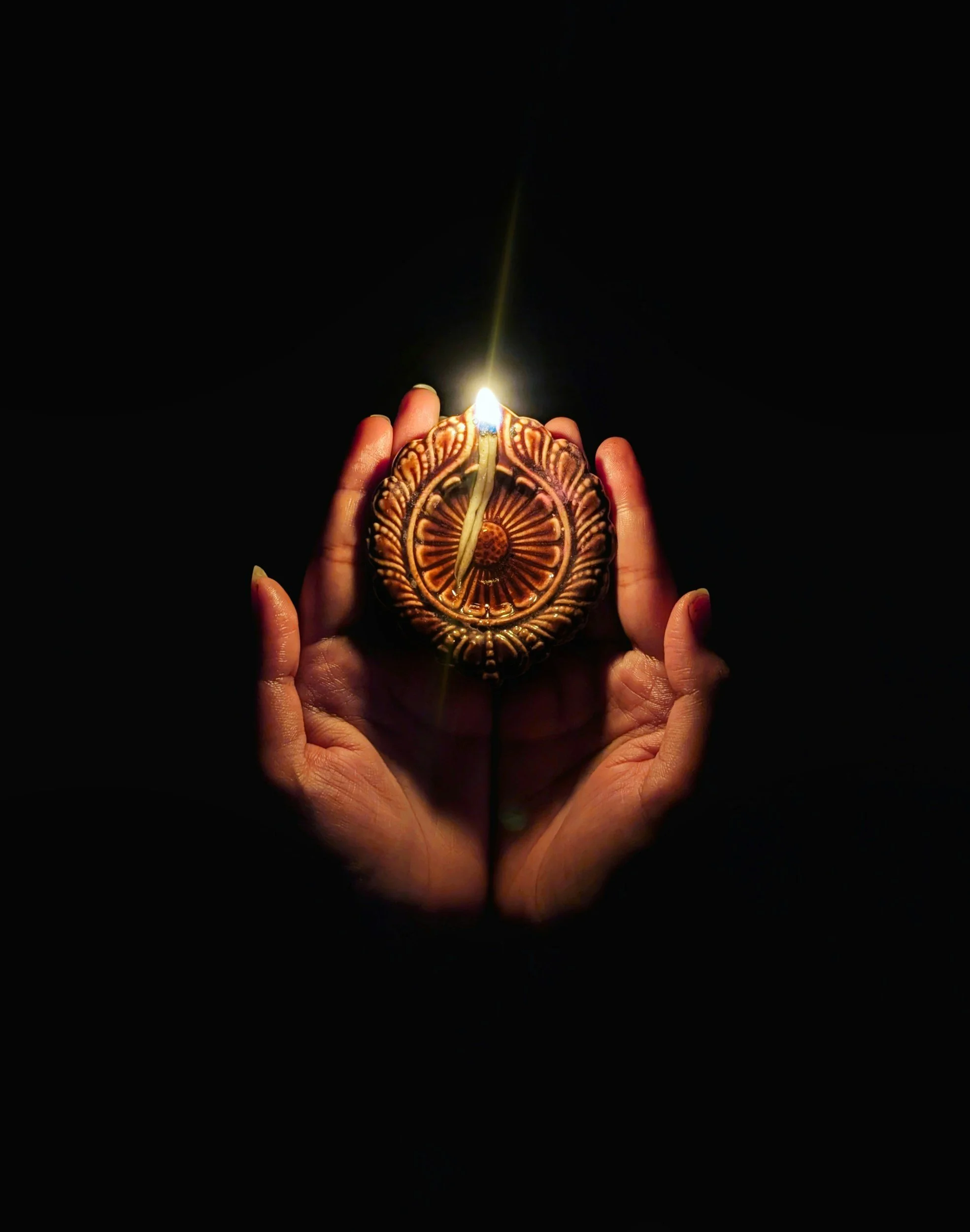
Being desirable means being comfortable with your own ambiguity. The most ambiguous reality is that we are flesh and spirit at the same time. Within everyone there is light and shadow, good and evil, love and hate. In order to be truthful, you must embrace your total being. A person who exhibits both positive and negative qualities, strengths and weaknesses is not flawed, but complete. ~ Rumi
A Practice for Inner Radiance & Renewal
There are seasons when the world around us seems quieter, darker, or less certain. We may find ourselves reaching for answers, pushing toward the next accomplishment, or trying to make everything feel bright again. Yet sometimes the most meaningful thing we can do is pause.
Darkness does not always ask to be conquered. Sometimes it invites us to listen more closely, to notice what has been hidden beneath the noise of daily life, and to become more familiar with the quiet light within ourselves.
This is one of those moments when we can soften our striving and allow stillness to become a source of understanding. Rather than measuring our strength by how much we accomplish or how successfully we overcome a challenge, we can begin to recognize the strength that comes from patience, self-awareness, and trust.
There is a difference between trying to manufacture light and learning to recognize the light that is already there.
Our practice this week is an invitation to make room for both darkness and radiance, to let one inform our understanding of the other, and to remember that our inner light does not disappear simply because the path ahead is not yet clear.

Padme (Lotus) Mudra
Gesture of Connection & Reception
Padma (Lotus) Mudra, often called the Lotus Mudra, is a heart-centered hand gesture inspired by the opening of a lotus flower. The palms come together while the fingers gently spread outward, creating the shape of a blossoming flower.
The lotus offers a meaningful image for this practice. Its beauty is not separate from the conditions in which it grows. It rises from dark, muddy water and opens toward the light. In much the same way, our own growth does not require perfect circumstances. We can discover beauty, clarity, and resilience even during uncertain or difficult times.
Padma Mudra invites us to soften around the heart, become receptive to our own experience, and make space for the possibility of renewal.
How to Practice
Sit comfortably with your spine naturally upright and your shoulders relaxed.
Bring your palms together in front of your heart.
Keep the heels of your palms, thumbs, and little fingers gently touching.
Slowly open the remaining fingers outward, allowing them to spread like the petals of a flower.
Keep the gesture soft. There is no need to stretch or force the fingers.
Rest your hands in front of your heart and breathe naturally.
Remain here for several comfortable breaths, allowing your attention to settle. If it feels supportive, imagine a flower slowly opening within you, not because everything around it is easy, but because opening is part of its nature.
Remember: There is no need to force the position or the breath. Keep the hands soft and choose whatever feels comfortable for your body. If closing your eyes feels uncomfortable, simply keep them open with a soft gaze.
Supportive Qualities
Intention - Bringing attention to what you wish to cultivate.
Self-Worth - Recognizing that your value extends beyond material success or the approval of others.
Receptivity - Allowing yourself to receive help, care, opportunity, and kindness.
Discernment - Choosing where your resources, attention, and energy are best placed.
Generosity - Sharing from a place of genuine care rather than obligation or depletion.
A Gentle Note
The lotus does not hurry its blossoming. It does not compare itself to another flower or wait for the water to become perfectly clear.
You are allowed to grow at your own pace.
You do not need to turn every difficult experience into a lesson immediately. You do not need to find a silver lining in every moment or pretend that darkness is not difficult.
Sometimes the most compassionate thing we can do is acknowledge what is present, give ourselves room to feel, and trust that understanding may come in its own time.
Let this gesture remind you that your radiance is not something you must earn. It is something you can learn to recognize, even when life feels uncertain.
CAUTION
Keep your hands, fingers, and wrists comfortable. The fingers should open only as far as they naturally allow; there is no need to create a wide or perfectly symmetrical flower shape.
If you experience pain, numbness, tingling, cramping, or strain, release the gesture and allow your hands to rest comfortably in your lap. You can also modify the practice by bringing your palms together without spreading the fingers.
Let the gesture be an invitation to soften, not another thing to do perfectly.
🔊 Mantra | Om Jyotir Aham | I Am Light
Om Jyotir Aham (ॐ ज्योतिरहम्) is a Sanskrit contemplative phrase that can be understood as “I am light.”
Jyotir refers to light, radiance, or illumination, while aham means “I” or “I am.” The phrase offers a simple yet profound reflection on the light of awareness within us.
Light is often associated with clarity, understanding, and the ability to see what was previously hidden. In this practice, we are not asking ourselves to deny difficult feelings or pretend that life is always bright. Instead, we are remembering that uncertainty, grief, and periods of darkness do not erase our inherent worth or our capacity for awareness.
The mantra invites us to turn inward, not to escape the world around us, but to recognize the steady presence that can remain even when circumstances change.
Rhythm & Practice
Begin by sitting comfortably with your hands resting in Padma Mudra.
Take a few natural breaths. As you inhale, gently bring your attention inward. As you exhale, allow your shoulders and jaw to soften.
Chant or repeat:
Om Jyotir Aham
Pronunciation: Ohm JYOH-teer AH-hum.
Repeat the phrase slowly, allowing each repetition to settle before beginning the next. You can chant aloud, whisper it, or repeat it silently.
If you are new to Sanskrit mantras, begin with three repetitions. With time, you may wish to repeat it 9, 27, or 108 times, according to your own practice and comfort.
Choose One Action (or as many as you like)
Create a little darkness.
Spend 10–15 minutes without screens, music, or other distractions. Sit quietly, perhaps with a candle nearby, and notice what arises when you stop filling every moment.Release the need to win.
Notice one situation in which you feel compelled to prove a point, have the last word, or control an outcome. Practice listening without preparing your defense. You don't have to abandon your perspective; simply make room for another.Let something rest.
Choose one nonessential task, obligation, or expectation and give yourself permission to postpone, simplify, or release it. Notice what becomes possible when you stop pushing.Offer quiet generosity.
Do something kind without needing recognition or a particular response. Let the action come from genuine care rather than obligation or the desire to be appreciated.Welcome beauty without earning it.
Bring something beautiful into your day simply because it nourishes you: flowers, fresh air, music, a favorite scent, or a quiet cup of tea. Let receiving be enough.
🌿 Essential Oils for Stillness & Renewal
These oils have been chosen to support our exploration of inner radiance, reflection, and renewal. Frankincense invites stillness and contemplation, Cedarwood offers a sense of grounding and steadiness, and Bergamot brings a gentle note of brightness and emotional ease.
Together, these aromas offer a sensory reminder that we can remain grounded while allowing new light and perspective into our lives.
Choose one oil or create a gentle blend that resonates with you. As you breathe in its aroma, take a moment to consider what it might mean to allow the quiet within you to become a place of renewal.
Frankincense | Stillness & Inner Reflection
Frankincense has a warm, resinous aroma that has long been valued in contemplative and aromatic traditions. Its scent can serve as a gentle reminder to slow down, become present, and make room for reflection. Learn More
Reflection: What might become clearer if I gave myself permission to pause?
Cedarwood | Grounding & Steadiness
Cedarwood has a deep, woody aroma that can feel comforting and grounding. It offers a fitting companion for moments when we want to reconnect with steadiness rather than be carried away by uncertainty or the pressure to act. Learn More
Reflection: What helps me feel rooted when the way forward is not yet clear?
Bergamot | Brightness & Emotional Ease
Bergamot has a fresh, softly citrus aroma often associated with brightness and uplift. Its fragrance offers a gentle counterpoint to the heaviness that can sometimes accompany introspection, reminding us that lightness and depth can coexist. Learn More
Reflection: Where might I allow a little more ease, joy, or possibility into my life?
Essential Oil Safety & Contraindications
Skin application: Essential oils are concentrated substances. Do not apply them undiluted to the skin; use an appropriate dilution in a suitable carrier oil and follow the product's safety guidance. Do not ingest essential oils.
Inhalation and diffusion: Begin with a small amount, ensure adequate ventilation, and avoid prolonged or continuous diffusion. Stop if you experience headache, coughing, breathing irritation, nausea, or other discomfort. People with asthma, fragrance sensitivity, or respiratory conditions may prefer to avoid inhalation.
Allergies and sensitivities: Avoid oils that cause or may trigger an allergic reaction, skin irritation, or other symptoms. Oxidized essential oils, including older oils that have been exposed to air, heat, or light, may carry an increased risk of skin sensitization.
Pregnancy, children, and pets: Safety depends on the particular oil, concentration, exposure, age, and circumstances. Seek appropriate professional guidance before using essential oils around infants, young children, during pregnancy or breastfeeding, or around pets. Do not assume an oil safe for an adult is safe for a child or animal.
Sun exposure: Bergamot expressed essential oil can be phototoxic because of naturally occurring furocoumarins. If applying it to the skin, use a product specifically labeled FCF (furocoumarin-free) or bergapten-free, or follow the manufacturer's specific sun-exposure guidance. Steam-distilled bergamot does not have the same phototoxicity concern. Frankincense and Cedarwood are not generally considered phototoxic, but product-specific guidance should always be followed.
If you are unsure whether an oil is appropriate for you, leave it out. The practice is complete without aromatherapy.
🌸 Bach Flower Remedies for Renewal & Inner Direction
These remedies have been chosen to complement our exploration of stillness, emotional renewal, and reconnecting with our inner sense of direction. In the traditional Bach Flower Remedy system, Mustard is associated with periods of unexplained gloom, Olive with exhaustion after prolonged effort, and Wild Oat with uncertainty about one's direction or purpose.
They can be explored as reflective companions, offering an opportunity to consider what we may need emotionally as we move through periods of change.
Mustard | Lightness & Emotional Renewal
In the Bach tradition, Mustard is associated with deep periods of gloom or sadness that seem to arrive without an identifiable cause. Its traditional theme invites us to remain gentle with ourselves when our emotional landscape feels unexpectedly heavy. Learn More
Reflection: Can I allow myself to experience this moment without assuming it will define what comes next?
Olive | Restoration & Renewed Energy
Olive is traditionally associated with physical and emotional exhaustion following prolonged effort or difficulty. Its theme reminds us that rest is not a reward we must earn. It is a necessary part of caring for ourselves. Learn More
Reflection: Where have I been giving more than I have allowed myself to replenish?
Wild Oat | Direction & Inner Purpose
Wild Oat is traditionally associated with uncertainty about one's purpose or direction in life. It invites us to look beyond external expectations and listen for what feels meaningful and true. Learn More
Reflection: Am I following a direction that genuinely reflects my values, or one I feel expected to pursue?
How to use: Take as directed in water or under the tongue throughout the day.
A Note for Those with Allergies
If you have sensitivities or allergies to flowers, plants, herbs, alcohol, or other ingredients, always review the product label before choosing a Bach remedy. Formulations vary, and some preparations contain alcohol. Alcohol-free alternatives may be available.
Bach remedies are not established medical treatments, and research has not demonstrated benefits beyond placebo for the conditions studied. They should not replace appropriate medical or mental health care.
You can also connect with the qualities of these remedies without using the products. Consider the colors, flowers, words, or intentions they bring to mind. A moment of quiet reflection can be meaningful without any physical exposure to a plant or preparation.
You can explore these qualities through:
Visualization — imagine the plant or its natural surroundings.
Reflection — consider the qualities it represents, such as grounding, courage, compassion, protection, or renewal.
Words & Intention — choose a word, affirmation, or personal intention that expresses the quality you wish to cultivate.
Quiet Breathing — sit comfortably, breathe naturally, and allow yourself a few moments of stillness.
Ask yourself:
What quality am I drawn to cultivate?
How might I bring that quality into my daily life?
What simple action would help me embody it?
You do not need the physical plant or product to engage with its symbolic meaning. Sometimes an image, a word, a memory, or a quiet intention is enough to bring a meaningful quality into awareness.
The practice is the attention you bring, not the product you use.
If you have a known allergy, avoid exposure to the relevant allergen, check product ingredients carefully, and follow the guidance of your healthcare professional. Visualization and reflection offer ways to explore symbolic meaning without physical exposure. This document is intended for informational and educational purposes. Flower remedies & essential oils should be used as complementary wellness practices, not as replacements for professional medical or mental health care. Always consult a qualified healthcare provider before beginning any new health regimen, particularly if you are pregnant, nursing, taking medications, or managing a chronic health condition.
A Simple Ritual | Letting the Light In
Find a quiet place where you can sit comfortably for a few moments. If you wish, soften the lighting or light a candle, taking care to place it safely.
Begin by bringing your hands into Padma Mudra. Allow your breathing to settle into its natural rhythm.
Consider these questions:
What have I been striving to accomplish, prove, or overcome?
Is there an expectation I can soften or release?
What might the quieter parts of my experience be trying to show me?
Where do I already recognize light, strength, or possibility within myself?
There is no need to answer every question. Let one remain with you, and allow whatever comes forward to do so without judgment.
When you feel ready, repeat your mantra:
Om Jyotir Aham.
Allow the words to settle. Remember that the light you are recognizing does not require you to be free from difficulty. It simply asks you to become present to what remains within you.
Place your hand over your heart and say:
May I meet myself today with the same love I so freely offer others.
Rest in the quiet for a moment before returning to your day.
The Light That Was Never Lost
We often imagine that light and darkness exist in opposition, that one must disappear before the other can be welcomed. But perhaps there is another way to understand them.
Perhaps darkness can teach us to see differently. Perhaps uncertainty can help us recognize what remains steady. Perhaps the moments when we feel least certain are the very moments that invite us to listen more deeply.
We do not have to make every difficult experience beautiful. We do not have to rush toward understanding or pretend that every ending is easy. We can simply allow ourselves to be where we are, with patience and compassion.
Like the lotus, we can continue to open. Not because the conditions around us are perfect, but because there is something within us that remains capable of growth.
May we remember that radiance is not the absence of darkness. It is the light we learn to recognize, nurture, and carry within us.
“Let everything happen to you: beauty and terror. Just keep going. No feeling is final.”
Rainer Maria Rilke, Go to the Limits of Your Longing
With Love & Care,
Carlie Love, LMBT, CIMI
Petals & Planets | Seasonal Wisdom for Body & Soul
